

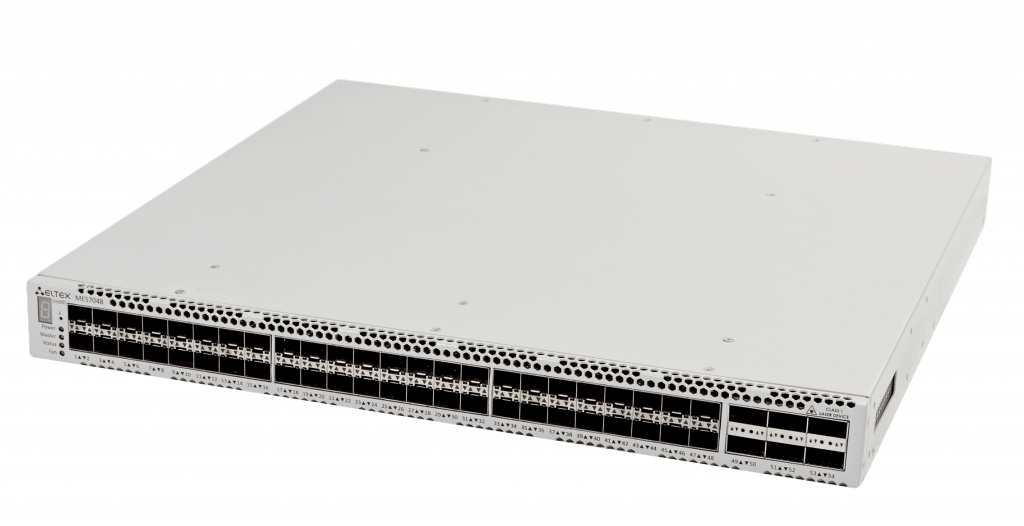


Aggregation 100G Switch MES7048
Overview
Specifications
Reviews
Key features
- 48x10GBASE-R (SFP+) / 1000BASE-X (SFP) interfaces
- 6x40GBASE-SR4/LR4 (QSFP+) / 100GBASE-SR4/LR4 (QSFP28) interfaces
- Bandwidth – 1.92 Tbps
- Non-blocking architecture
- Front-to-Back cooling
- Stacking up to 8 devices
- Hot-swappable redundant power supplies
- Hot-swappable fans
The device’s ports support operation at rates of 1 Gbps (SFP), 10 Gbps (SFP+), 40 Gbps (QSFP+) and 100 Gbps (QSFP28).
The non-blocking architecture guarantees lossless packet forwarding at wire speed with minimum and predictable delays for all types of traffic. The front-to-back cooling provides effective cooldown in modern data centers.
The redundant and hot-swappable fans and AC/DC power supplies along with advanced hardware monitoring functions provide high reliability and uninterrupted services.
Interfaces
-
1x10/100/1000BASE-T (OOB)
-
48x10GBASE-R (SFP+) / 1000BASE-X (SFP)
-
6x40GBASE-SR4/LR4 (QSFP+) / 100GBASE-SR4/LR4 (QSFP28)
- 1xUSB 2.0
- Console port RS-232 / RJ-45
General features
- Packet processor - Broadcom BCM56860 (Trident2+)
- Bandwidth - 1.92 Tbps
- Throughput for 64 bytes - 1607 MPPS
- Buffer memory - 16 MB
- RAM (DDR3) - 4GB
- ROM (NAND) - 8GB
- MAC table - 228K
- VLAN table - 4K
- L2 Multicast groups - 2K
- SQinQ rules - 4K
- Link Aggregation Groups (LAG) - 64, 32 ports per LAG
- IPv4 routes - 16K
- IPv6 routes - 8K
- ARP table - 6K
- VRRP routers - 20
- L3 interfaces - 128
- ECMP-groups - 16
- Loopback interfaces - 64
- Quality of Service (QoS) - 7 queues per port
- TCAM - 16K Ingress, 1K Egress
- Jumbo frames size - 9416 bytes
- Head-of-line blocking (HOL) protection
- Back Pressure
- Auto MDI/MDIX
- Jumbo Frames
- Flow Control (IEEE 802.3X)
- Protected ports
- Link Aggregation Groups (LAG)
- LACP
- Different LAG balancing algorithms
- IEEE 802.1Q
- GVRP
- MAC/IP-based VLAN
- Different VLAN port operating modes
- Voice VLAN
- Independent VLAN learning
- Private VLAN
- Layer 2 Protocol Tunneling
- MAC Multicast Support
- Static MAC filtering
- Port/VLAN MAC locking
- IGMP Snooping v1,2,3
- Port/host-based IGMP Snooping Fast Leave
- MLD Snooping v1,2
- MGMD Snooping SSM
- IGMP and MLD Snooping Querier
- MVR
- GMRP
- STP (Spanning Tree Protocol, IEEE 802.1d)
- RSTP (Rapid Spanning Tree Protocol, IEEE 802.1w)
- MSTP (Multiple Spanning Tree Protocol, IEEE802.1s)
- PVSTP (Per VLAN Spanning Tree Protocol)
- PVRSTP (Per VLAN Rapid Spanning Tree Protocol)
- Spanning Tree Fast Link option
- STP Root Guard
- STP Loop Guard
- BPDU Filtering
- STP BPDU Guard
- Loopback Detection (LBD)
- Static routing
- Inter VLAN routing
- Dynamic routing protocols RIP, OSPFv2, OSPFv3, BGP
- Address Resolution Protocol (ARP)
- Proxy ARP
- VRF
- Policy-Based Routing
- BFD
- VRRP
- ECMP Load Balancing
- UDP Relay/IP Helper
- ICMP Throttling
- Loopback interfaces
- IPv6 Host
- IPv6 DHCP Client (Statefull/Stateless)
- DHCPv6 Server
- IPv4 and Ipv6
- ICMPv6 Throttling
- DHCP snooping (IPv4 and IPv6)
- IP source guard (IPv4 and IPv6)
- Dynamic ARP Inspection
- IPv6 RA Guard (Stateless)
- MAC-based authentication, Port Security, Static MAC entries
- Port-based authentication IEEE 802.1x
- Guest VLAN IEEE 802.1x
- DoS attack prevention
- Traffic segmentation
- Protection against non-authorized DHCP servers
- DHCP clients filtering
- BPDU attack prevention
- NetBIOS/NetBEUI filtering
- L2-L3-L4 ACL
- Time-Based ACL
- IPv6 ACL
- ACL based on:
- Source/destination MAC/IP/IPv6 address
- Physical port number
- IEEE 802.1p
- VLAN ID
- EtherType
- TOS/DSCP/Preference
- Protocol type
- TCP/UDP source/destination port
- ACL actions:
- Egress queueing
- Flow-based redirecting and mirroring
- ACL-based fixed rate limiting
- Generation of trap log entries containing rule hit count
- QoS statistics
- Shaping, policing
- IEEE 802.1p Class of Service (CoS)
- Interface trust mode: IEEE 802.1p, IP DSCP
- IEEE 802.1p and IP DSCP-based traffic classification and mapping
- Storm control
- Interface bandwidth management
- Bandwidth management per queue
- Strict priority and weighted (WRR/WFQ) scheduling algorithms
- ACL-based CoS/DHCP mark assignment
- Tail Drop/Weighted Random Early Detection (WRED) queue depth management
- Automatic VoIP Class of Service (CoS) settings
Management functions
- Configuration file download and upload via TFTP/SCP/FTP/SFTP and USB
- Software file download and upload via TFTP/SCP/FTP/SFTP and USB
- SNMP v1, v2, and v3
- Command Line Interface (CLI)
- SSH server
- Web interface
- NETCONF
- Syslog
- SNTP (Simple Network Time Protocol)
- Traceroute/Ping
- Authentication, Authorization and Accounting (AAA)
- Local authentication
- Command authorization
- RADIUS, TACACS+
- Management interface blocking
- SSL
- Macrocommands
- CLI command logging
- System log
- DHCP auto-provisioning
- Debugging commands
- CPU traffic limiting mechanism
- Command completion
- Context-sensitive help
- Password encryption
- Management access control lists
- Interface statistics
- Port mirroring (SPAN)
- Remote port mirroring (RSPAN)
- Remote monitoring (RMON/SMON)
- sFlow
- Task- and traffic type-based CPU utilization monitoring
- RAM utilization monitoring
- Temperature monitoring
- LLDP (802.1ab) + LLDP MED
- Virtual Cable Testing (VCT)
- Optical transceiver diagnostics
- Ethernet OAM
- IEEE 802.1ag Connectivity Fault Management (CFM)
- Unidirectional Link Detection (UDLD)
- Layer-2 Protocol Tunneling (L2PT)
- IEEE 802.1ad Double VLAN tagging (in compliance with TR-101)
- Quantized Congestion Notification (QCN)
- Enhanced Transmission Selection (ETS)
- Priority-Based Flow Control (PFC)
- Data Center Bridging Exchange Protocol (DCBX)– MLAG (Virtual Port Channel)
- FIP Snooping
- OpenFlow v1.0/v1.3.4
- Cut-through switching
- Redundant Management Unit support
- Single IP address management
- Automatic election of management control unit
- Automatic software and configuration update throughout stack
- Hot-swap of stack units
- Offline configuration of stack units
- Stacking (up to 8 switches in a stack)
- IEEE 802.3 10BASE-T
- IEEE 802.3u 100BASE-T
- IEEE 802.3ab 1000BASE-T
- IEEE 802.3ac VLAN tagging
- IEEE 802.3ad Link aggregation
- IEEE 802.3ae 10GbE
- IEEE 802.3bj- Forward Error Correction (FEC) CL91
- IEEE 802.1ak Multiple Registration Protocol (MRP)
- IEEE 802.1as Timing and Synchronization for Time-Sensitive Applications in Bridged Local Area Networks
- IEEE 802.1s Multiple Spanning Tree compatibility
- IEEE 802.1w Rapid Spanning Tree compatibility
- IEEE 802.1D Spanning Tree Compatibility
- IEEE 802.1Q Virtual LANs with Port-based VLANs
- IEEE 802.1ad Double VLAN tagging (TR-101)
- IEEE 802.1ag Connectivity Fault Management (CFM)
- IEEE 802.3ah Operations, Administration and Maintenance (OAM)
- IEEE 802.1Qat Multiple Stream Reservation Protocol (MSRP)
- IEEE 802.1Qav Forwarding and Queuing Enhancements for Time-Sensitive Streams
- IEEE 801.1Qbb Priority-based Flow Control
- IEEE 802.1Qau Virtual bridged local area networks amendment 13: congestion notification (Draft 2.4)
- IEEE 802.1Qaz Enhanced transmission election for bandwidth sharing between traffic classes (Draft 2.4)
- IEEE 802.1v Protocol-based VLANs
- IEEE 802.1p Ethernet priority with user provisioning and mapping
- IEEE 802.1X Port-based authentication and supplicant support
- IEEE 802.3x Flow control
- IEEE 802.1AB Link Layer Discovery Protocol (LLDP)
- ANSI/TIA-1057 LLDP-Media Endpoint Discovery (MED)
- IEEE 1588v2 Precision Time Protocol (PTP)
- RFC 768 UDP
- RFC 783 TFTP
- RFC 791 IP
- RFC 792 ICMP
- RFC 793 TCP
- RFC 826 Ethernet ARP
- RFC 894 Transmissions of IP datagrams over Ethernet networks
- RFC 896 Congestion control in IP/TCP networks
- RFC 951 BootP
- RFC 1034 Domain names - concepts and facilities
- RFC 1035 Domain names - implementation and specification
- RFC 1321 Message digest algorithm
- RFC 1534 Interoperation between BootP and DHCP
- RFC 2021 Remote Network Monitoring Management Information base v2
- RFC 2030 Simple Network Time Protocol (SNTP) v4 for IPv4, IPv6, and OSI
- RFC 2131 DHCP Client/Server
- RFC 2132 DHCP options and BootP vendor extension
- RFC 2347 TFTP option extension
- RFC 2348 TFTP block size option
- RFC 2819 Remote Network Monitoring Management Information Base
- RFC 2865 RADIUS client
- RFC 2866 RADIUS accounting
- RFC 2868 RADIUS attributes for tunnel protocol support
- RFC 2869 RADIUS Extensions
- RFC 3162 RADIUS and IPv6
- RFC 3164 The BSD syslog protocol
- RFC 3580 IEEE 802.1X RADIUS usage guidelines
- RFC 4541 IGMP Snooping and MLD Snooping
- RFC 5171 Unidirectional Link Detection (UDLD) Protocol
- RFC 5176 Dynamic Authorization Server
- RFC 5424 The Syslog Protocol
- RFC 1027 Using ARP to implement transparent subnet gateways (Proxy ARP)
- RFC 1256 ICMP router discovery messages
- RFC 1765 OSPF database overflow
- RFC 1812 Requirements for IP version 4 routers
- RFC 1997 BGP Communities Attribute
- RFC 2082 RIP-2 MD5 authentication
- RFC 2131 DHCP relay
- RFC 2328 OSPFv2
- RFC 2370 OSPF Opaque LSA Option
- RFC 2385 Protection of BGP Sessions via the TCP MD5 Signature Option
- RFC 2453 RIP v2
- RFC 2545 BGP-4 Multiprotocol Extensions for IPv6 Inter- Domain Routing
- RFC 2918 Route refresh capability for BGP-4
- RFC 3021 Using 31-Bit Prefixes on IPv4 Point-to-Point Links
- RFC 3046 DHCP/BootP relay
- RFC 3101 The OSPF “not so stubby area” (NSSA) option
- RFC 3137 OSPF stub router advertisement
- RFC 3623 Graceful OSPF restart-
- RFC 3704 Unicast Reverse Path Forwarding (uRPF)
- RFC 3768 Virtual Router Redundancy Protocol (VRRP) version 2
- RFC 5187 OSPFv3 Graceful Restart
- RFC 5340 OSPF for IPv6
